When Your Nervous System Still Thinks It’s 1987
How old protective patterns keep trying to help – even when life has moved on
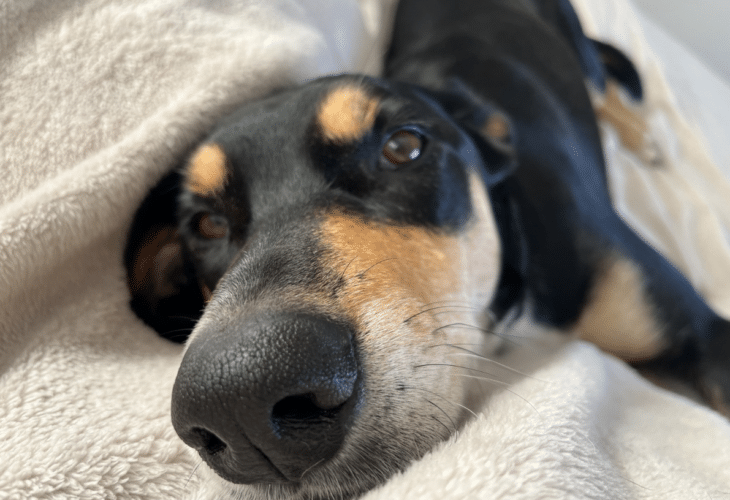
I’ve been looking after a gorgeous dog for a few weeks.
Meet Mojo.
When I was out throwing the ball in the sun with him the other afternoon, some school children came by. I immediately called out to let them know he was friendly, as people are often understandably cautious of dogs off the lead.
A little girl, about five years old, was walking with her big brother, and he put his arm around her as they approached. Mojo was about 20 feet away, happily minding his own business, but she was clearly afraid. I reassured her, but I could see in her face that she was not entirely convinced.
And honestly, I understood.
It took me right back to my own childhood and being afraid of most dogs. I had encountered quite a few scary ones on my walk to school over many years, and also had some unsettling interactions with a large Alsatian that belonged to a family friend when I was a child and teenager.
It was all pretty off-putting, to be fair.
It wasn’t really until I was in my 30s that I became more comfortable around dogs. That was when I began to realise that many, if not most, dogs are actually pretty cool. I also developed more discernment around which ones were friendly and which ones were best given a wide berth.
Because of that, I’ve been able to enjoy making friends with numerous beautiful dogs over the years – dogs belonging to friends, aunts and uncles, my parents’ beloved Molly who passed away last year, and now Mojo.
It occurred to me that this is a pretty good example of how the brain and nervous system can generalise perceived danger from earlier experiences. And it does this across a whole host of situations, not just dogs.
Something happens and the body registers danger. Then, later, when a person, place, tone of voice, circumstance or even economic climate feels familiar enough, the nervous system may respond as though the original situation is happening again.
Even when it isn’t.
A few years ago, I worked with a client who had gone through a particularly stressful experience during the Global Financial Crisis, when she was suddenly and unexpectedly made redundant. More than ten years later, as economic pressure rose again during the pandemic, she found herself feeling surprisingly debilitated by it, even though there was no redundancy in sight.
To her logical adult self, the reaction didn’t make complete sense, but to her nervous system, there were enough familiar red flags: economic uncertainty, pressure in the air, the sense of something unstable happening around her.
Her system was essentially saying, “Last time this happened, it wasn’t safe.” Red alert.
It reminded me how long the drama of the 1987 stock market crash stayed with me – and I was only 12 and not actually dealing with it directly! But it was happening to the people around me: my Dad, my grandparents and many, many other people. We can absorb the fear and stress of difficult events even when they’re happening to someone around us.
And in many ways, that’s the nervous system trying to do its job. The amygdala plays a part in tracking for danger, helping us recognise potential threats and respond to them. It’s trying to protect us from a repeat experience, sometimes even one we’ve witnessed rather than experienced directly.
But sometimes it’s a bit like having a guard dog that barks at everything that moves, rather than just the dodgy strangers.
Useful? Potentially. Exhausting? Absolutely.
The same thing can happen with people in authority if you had an aggressive teacher, a critical parent or an abrasive first boss. Later in life, you may find yourself feeling tense, small, defensive or overly careful around certain people, even when they have done nothing particularly wrong.
Or you might flick into a hammer of anxiety when you need to ask for something with a loved one, colleague or client. On the surface, it might be a completely reasonable request. But if, somewhere along the way, asking for what you needed was met with harshness, rejection or ridicule, the body may register the moment as confrontation.
Not because you’re being silly, weak or because you haven’t “worked on yourself enough”, but because some part of your system learned that this situation required protection.
That’s the thing about these patterns. They don’t always make logical sense to the adult self, because they’re not necessarily being driven by conscious, logical thought. They can be held in the body’s learned responses, emotional associations and unconscious patterns of memory and protection.
This is why simply talking ourselves out of a reaction only takes us so far.
We can understand something perfectly well and still have the body respond differently. We can know the dog is friendly and still feel afraid, or know the conversation is safe and still feel anxious. We can know there is no immediate threat and still feel our system brace, shrink, defend, freeze or flare.
This is where I think compassion becomes incredibly important.
So many of the responses we judge in ourselves are simply old protective patterns still doing what they were designed to do. They may be outdated, inconvenient or wildly disproportionate to the current moment, but at some point they were trying to keep us safe.
And when we see them that way, we can start to meet them differently.
Not with frustration, not with “Why am I like this?” or with another round of self-improvement pressure, but with curiosity, kindness and the willingness to gently unwind what is no longer needed.Attending to these underlying patterns can be deeply liberating. Sometimes there is a moment where you realise that what you thought was simply your personality – “I’m just anxious about that,” “I’m bad at confrontation,” “I don’t like authority figures,” “I’m not good with uncertainty” – may actually be a learned response that has been running on default.
And defaults can change. They are not You.
This is not about forcing yourself to be braver, tougher or more rational. It’s about helping the body and nervous system recognise that the present moment is not necessarily the same as the past.
This person is not that person. This dog is not that dog. This conversation is not the old one, and this season of uncertainty is not necessarily a repeat of what happened before.
And you are not the same person you were then.
The more we can recognise these patterns with compassion, the more choice we have. We can begin to respond from the truth of the current moment, rather than from an old map of danger that may no longer be accurate.
To me, that is a profound kind of freedom.
Because as we become less driven by old protective patterns, more of our energy becomes available for life now. For ease, courage, clearer choices, connection and trusting ourselves.
And yes, sometimes, for throwing a ball in the sunshine with a sweet doggy, and realising just how much can change.
Karen x
Share the Love >